Obsolete, Shmobsolete

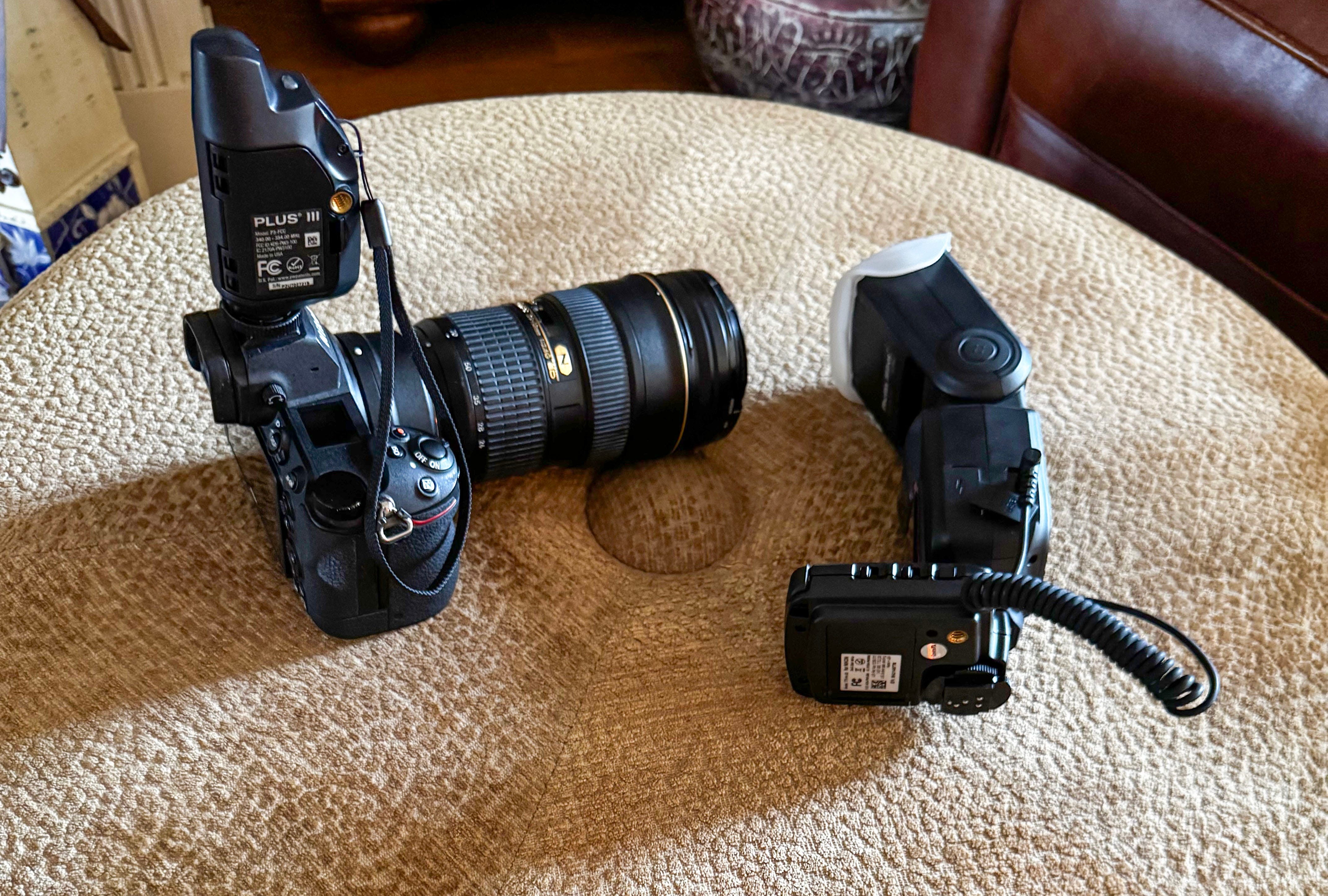
In the summer of 2024, I bought a Nikon z7ii mirrorless camera body to replace my trusty old D800. It is truly a great camera. I don’t regret one penny of the purchase. It is truly a sweet machine.
The transition did not happen without some friction. With the new “Z” line of camera bodies, Nikon changed some of their technology. I can’t say I blame them, but I couldn’t help grumbling about it.
The biggest change is a new lens mount — the “Z” mount, with a whole line of “Z” lenses. I have a camera bag with several top-of-the-line Nikon lenses, all with the venerable “F” mount, which would not fit the camera. The purchase of a Nikon FTZ lens adapter solved that one. Piece of cake.
The stickier problem was my flash. I’d burned through a couple of Nikon speedlights over the years, and I bought an inexpensive Phottix Mitros a few years ago. It works great and was significantly less expensive than its Nikon counterpart. The problem? The Mitros won’t work in Through-The-Lens (TTL) mode on the z7ii (btw - an older Nikon won’t either).
TTL is a bit of magic, whereby the camera tells the flash how to set itself to give the best exposure for the shot it sees. Consider it “auto mode” for the flash. It adjusts power and zoom, and usually delivers an adequate exposure. It is not foolproof. It is good if you’re in a hurry, but great shots require a bit more craft. Shooting in manual mode is almost always better.
In 2024, I shrugged my shoulders and moved on. I don’t do much work that requires flash. I’ve been avoiding portraits and family shoots for the past few years. Not so much because I don’t want to do them, but I didn’t think I was that good at it. I think it was mostly stress avoidance. Landscapes don’t get disappointed if you blow the shot.
Recently, I’ve had several requests for portraits and event photography, and I’ve decided to start accepting them as they come in. I’m not advertising, mind you, but I’m not reflexively refusing either.
So, in 2026, I’m back to the flash problem. First, thank God for LensRentals.com. I can get a Nikon SB-5000 speedlight for a week for $30. I rented two for a recent event. Great solution. But I’m cheap. It only takes a few rentals to spend as much or more than just buying the thing outright. I thought I was at the point of slapping leather and getting another speedlight.
As I was browsing Nikon speedlights at the B&H website, I had a thought: “Wait a minute! TTL won’t work, but I wonder if the Phottix will work in manual mode? Forget TTL. I usually do anyway. Why can’t I just calculate my own flash settings, like back in the day?” I dug in the closet and found the flash. I put it in manual mode and put it on the camera. Cha-ching! Works fine.
Awesome, but how can I make it work off-camera?? “Smart” speedlights are also used to trigger other flashes sitting on a stand somewhere. I lost that capability too.
My photography idol, Joe McNally, once compared lighting a scene with on-camera flash to getting a driver’s license picture. I think he’s being generous. The z7ii doesn’t have a built-in flash, and I wouldn’t use it if it did. I only use a speedlight on the camera if I don’t have a choice. Nikon still supports optical control of remote flashes, but they’ve also added a very slick wireless radio solution. The problem is that they only work with the latest generation of Nikon speedlights.
The little wheels and circuits inside my photography-nerd brain were redlining.
I dug way back into the closet and found my “lighting case.” I found all my old PocketWizard radios. About 12 years ago, I bought a Flex TT5 and two PLUS III transceivers. Can I put something together with all this? Will these relics even power up after sitting in that box for years?
The adventure began.
The hypothetical configuration was a PLUS III unit on the z7ii body, talking to the TT5 mounted on a light stand with the flash sitting in the hot shoe on the top of the unit. The flash is set to manual mode — just dumping a big pile of light onto whatever it is pointed at.
First, the PLUS III on the camera. Batteries in, power on, test button, and the LED lit up red. So far, so good. Next, the TT5. Batteries in, power on, test button, and again the red LED. Now match the channels on the two units. Channel 1 for both. Hit the button. Nothing. Hmm.
After much fiddling and tweaking, I realized that somewhere in the TT5's past life, it had been reprogrammed to communicate on channel 17. I matched the channel on the PLUS III and confirmed the link. The radios were talking, but no flash yet.
Batteries in the flash. It powered up and fired when the test button was pressed. I mounted it in the TT5’s hot shoe, and right on cue, it started acting strange. High Speed Sync (HSS) lit up on the display out of nowhere. The settings on the flash were right - manual mode, power at 1/16, and zoom at 50mm. It turned out that the TT5’s hot shoe — built for full digital pass-through to a real Nikon body — was feeding the flash a signal on a handful of orphaned pins with nothing behind them. No camera, no protocol, just stray voltage the flash was doing its best to interpret.
The solution was the photographer’s best friend. I put a few small pieces of gaffer’s tape over the TT5’s data pins, leaving the center contact and the locking pin bare. HSS vanished the moment the tape went on.
Press the shutter. Still no flash.
It turned out that even a masked hot shoe wasn’t enough — something about contact depth, the flash foot not seating quite flush with the center pin on the TT5 hot shoe. So the last piece of the puzzle was to bypass the hot shoe altogether and use a $5 sync cable to connect the TT5 to the flash via the sync ports.
It fired. Every time, on command, from a stand thirty feet away.
I still don’t have TTL. I have to think in guide numbers and stops now instead of letting the meter do it for me. That’s fine. That’s the kind of math I learned on film cameras back in the 1970s.
But the most important thing is that I got a perfectly workable solution without ringing up a $600 tab at B&H. A drawer full of “obsolete” gear, back at work. And somewhere out there, an engineer at PocketWizard, who built a channel-matching system in the 1980s, is smiling for some unknown reason this morning. He never imagined that a TT5 unit would end up spliced together with a Phottix flash and a strip of gaffer’s tape triggered through a PLUS III on a Nikon camera nobody had even dreamed of yet — and still fire, clean and sure, every single time.
And this is why I don’t throw away technology. You just never know.
Obsolete, shmobsolete.
Thanks for reading But Now I See!
Subscribe free here.
This makes me think about my beloved Nikon FM1 that I still have somewhere. It has a built-in light meter, but that's all the fancy stuff. Titanium steel body and all that sort of thing. Of course, film. I don't know that I'll ever use it again, but that was a workhorse for me for a long time.